Most people furnishing a small apartment for a cat start with the toys. That is backwards. The two purchases that actually change how a cat lives in 600 square feet are a tower tall enough to count as vertical territory, and a place to put the litter box that is not the middle of your bathroom floor. Get those two right and the cat stops treating your bookshelf as a perch and your rug as a litter box. Get them wrong and you spend the next year patching carpet.
A cat tower and litter box setup in a small apartment is really two decisions: where the tower stands, and where the box hides. Everything else, the beds, the tunnels, the crinkle balls, is decoration.
I have been a veterinary technician for eight years and a foster mom to more than 60 cats. I have assembled, repaired, and watched cats destroy more cat trees than I can count, from cheap carpet-wrapped units to solid wood condos that cost more than my couch. Here is the order I would set up a small apartment, and the two pieces I would start with.
Why you should trust me
I work in a clinic four days a week and run a foster room the other three. Right now that room holds five cats, which means every piece of furniture in there gets jumped on, scratched, slept in, and occasionally knocked over by a group that does not care about my opinion.
Eight years of that teaches you what a product page cannot. Cats scratch to communicate, not to destroy. They climb because height feels safe. They avoid a litter box that smells like a predator lives next to it. A tree that tops out below your waist is a rug with legs, and a litter box sitting in the open is an invitation for a cat to find somewhere quieter, like your laundry pile.
Scratching is communication. Give them the right surface or they will pick your couch, and they will win that argument every time. That is the lens I use on every piece of furniture I bring home.
How I picked and how I tested
Every tree and every box that comes through my door runs the same four questions. I do not make a recommendation until a piece clears all four.
First, does it survive a 12-pound cat launching onto the top perch? For a tower, that means a rigid frame and a base plate that is wide relative to the height. Steel and solid wood pass. Particle board with a skinny base does not, no matter how pretty the product photos are.
Second, are the posts a material a cat will actually use? Carpet-wrapped posts are the enemy. They teach a cat that carpet is a scratching surface, and then your stairs become the next post. Look for a dedicated scratching post or a replaceable surface, and check the listing photos for the actual material before you order.
Third, is the base wide enough to never wobble on carpet? Wobble is the dealbreaker. If a tower rocks when a cat lands on it, the cat stops using the top perch, and you have paid for height the cat refuses to trust.
Fourth, would I put it in a foster room with five cats? That is the real test. Five cats means five opinions, five body weights, and five sets of claws working on the same furniture every day.
Litter box furniture gets a different checklist. Is the opening big enough for a full-grown cat to walk through without ducking? Does the door style let you scoop fast, or does it make you lift a lid with one hand while holding a bag in the other? Is there enough interior room for a box the cat can turn around in? And does it vent, or does it turn into a smell trap?
Those questions are why the two pieces below made the cut for a small apartment, and why a lot of the alternatives did not.
The tower comes first
Vertical territory is the reason to buy a tree at all. Cats want to be above the traffic in a room, which in a small apartment means above the back of the sofa and roughly at the eye level of a seated adult. A tower that reaches 43 inches puts the top perch in that zone. A tower that stops at 24 inches does not, and your cat will find the top of the refrigerator instead.
Placement matters as much as height. A corner is worth more than a flat wall because you get two surfaces bracing the tower instead of one. A spot near a window is worth more than a spot near a television, because cats want to watch something.
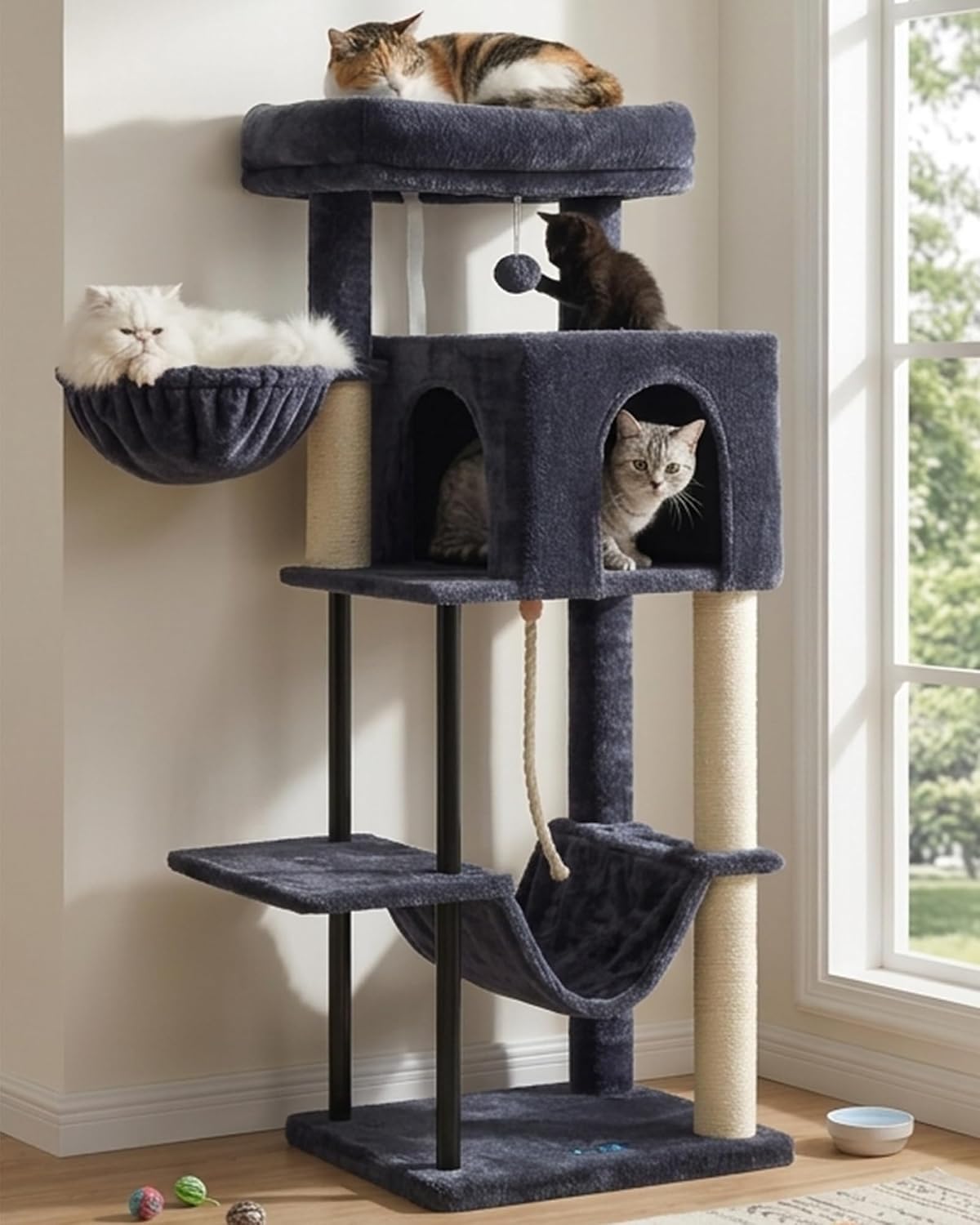
Budget pick: Gitelsnour Cat Tree, Cat Tower for Indoor Cats, 43.3 inch Cat Tree Tower with Sturdy Steel Tube, Hammock, Cat Condo for Small Cats and Kittens, Scratching Post, Smoky Gray GCT004SG
 Visit on Amazon →
This is the compact tower I would hand a first-time cat owner in an apartment. The spec that matters is the steel tube frame. Rigidity is what keeps a tower from developing the slow lean that ends with a cat refusing the top perch, and a steel frame is the honest way to get that at this size.
The rest of the layout covers the three things a cat actually uses. The hammock gives a low, cupped spot for a nervous cat who wants to be off the floor but not up high yet. The condo is a ground level hiding place, which matters in a studio where there is nowhere else to disappear. The scratching post gives a dedicated surface instead of your sofa arm. Smoky gray is a neutral that will not fight your furniture, which sounds like a small thing until you are staring at a bright blue cat tower in a 500 square foot living room.
The caveat is right in the product name, and I want you to read it carefully: this one is built for small cats and kittens. Believe the listing. If your cat is a 15-pound Maine Coon or a chunky senior who sprawls, the perches here will be tight and the top platform will not be the sprawl zone a big cat wants. That is not a flaw, it is a size class, and buying the wrong size class is the most common mistake I see.
Flaws but not dealbreakers: At 43.3 inches it is not a ceiling height cat palace, so if you have the floor space and the budget for a taller unit, you will get more vertical territory from that. For a one-bedroom or a studio, this footprint is the right trade.
Kittens, small adult cats, and anyone furnishing a first apartment should start here. Check current Amazon price before you commit.
The litter box half of the setup
The litter box is the part people get wrong in a small apartment, usually by leaving it in the open and then apologizing for it every time a guest comes over. A covered enclosure fixes that, but only if it is built for a cat and not just for the room.
What to look for: a door that opens without you lifting a lid, because you will scoop this thing twice a day for years. Enough interior room for a box the cat can turn around in, because a cramped box is a box a cat avoids. And a flat top you can actually use, because in a small apartment every horizontal surface is real estate.
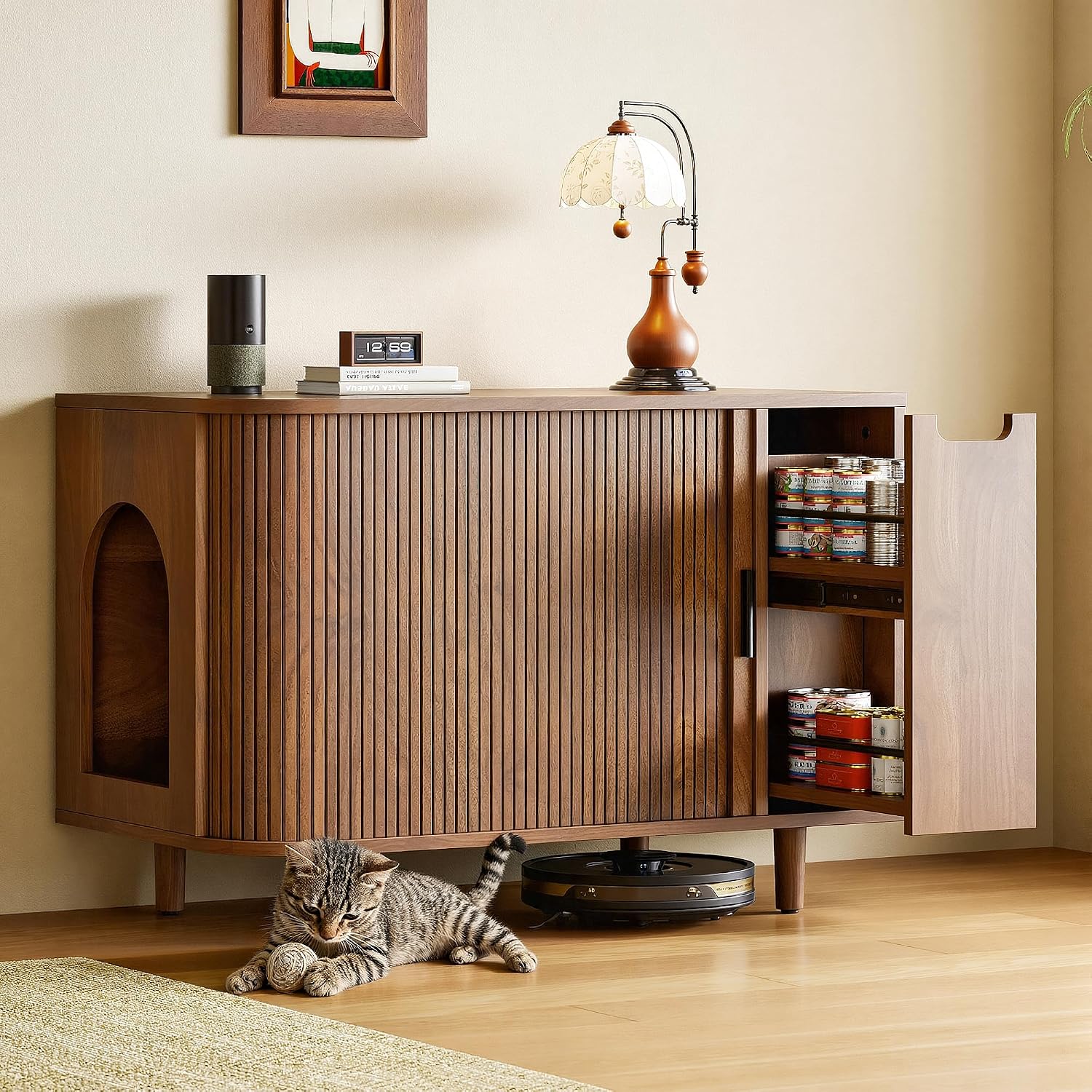
Our pick: IRONCK 35.4" Cat Litter Box Enclosure with Sliding Tambour Door and Drawer
 Visit on Amazon →
The sliding tambour door is the reason this one wins for apartments. A tambour door rolls to the side instead of swinging out, which matters when the only wall long enough for a litter station is in a hallway or beside a closet door. You get in, you scoop, you close it, and nothing bangs into the wall behind you.
The drawer is the second reason. Scoops, bags, liners, and a spare litter mat all live in the unit instead of on your floor, which is the difference between a litter station and a litter corner. At 35.4 inches wide it doubles as a console or an end table, so the box stops being a piece of pet equipment and starts being furniture, which is the entire point of buying an enclosure instead of a plastic hood.
The caveat here is measurement, and it is the one that ruins these purchases. Measure your cat's litter box before you order, then measure it again. An enclosure only works if the box inside leaves your cat room to step in, turn around, and dig. A box that fits with an inch to spare is a box your cat will use exactly once. Senior cats and arthritic cats may also prefer an open box, because a door, even a rolled one, is one more thing between them and getting there in time. For those cats, leave the door open permanently or skip the enclosure.
Flaws but not dealbreakers: It is furniture, so it is heavy, and assembly is a two-person job if you care about your knuckles. Keep the door track free of litter dust and the roll stays smooth.
Anyone whose litter box currently lives in a bathroom, a hallway, or plain sight in the living room should look here first. Check current Amazon price for the current listing.
The actual setup, step by step
Now the part you came for. This works in a studio, a one-bedroom, or any apartment where two cats share one litter station.
Step one: Measure the wall, not the room. You need a run of wall at least as wide as the tower base plus a hand's width of clearance. A corner is better than a flat wall because two walls brace the tower instead of one. If the only available corner is behind a door that swings, keep looking.
Step two: Put the tower where your cat already hangs out. Watch her for a day. If she already sits on the back of the couch, the windowsill, or the top of the bookcase, that is the spot. Cats do not adopt new territory that is far from where they already feel safe.
Step three: Anchor it. Tall furniture plus a jumping cat equals a tipped tower. If the tower does not include a wall strap, an inexpensive furniture anchor from any hardware store does the job. This is the step people skip and then regret.
Step four: Separate the box from the food. Cats do not eat where they eliminate, and they do not eliminate where they eat. In a small apartment, aim for opposite ends of the unit, and never put the litter enclosure beside the food bowl to save space. If you truly have one corner, put the food on the opposite wall and add a screen or a shelf between them.
Step five: Set up the box inside the enclosure before the cat sees it. Fill it, add a scoop of used litter so it smells like her, and leave the door open for the first week. Familiarity beats privacy at the start. Close it later if she is comfortable.
Step six: Watch the first jump. The first time a cat launches onto the top perch is the real test. If the tower shifts more than a hair, tighten every bolt, check that the base sits flat on the carpet, and add the wall anchor before you let her back up.
Step seven: Re-tighten everything after two weeks. Bolts on cat furniture work loose in the first month, because cats are basically a vibration test with claws. A two-minute check at the two week mark keeps a solid tower solid.
What I left out and why
Most of the towers I see in apartments fail the first question. The posts are wrapped in carpet, which is marketed as a comfort feature and functions as a scratching lesson aimed at your stairs. Skip those. The second most common failure is a tower with a tall profile and a base plate the size of a dinner plate. That is a tipped tower waiting for a 12-pound cat with a full head of steam.
On the litter side, I left out the plastic hooded boxes that cost almost nothing and smell like it. A hood traps odor in a small apartment, cracks at the hinge within a year, and gives you nowhere to store a scoop. If the budget is tight, an open box in a corner beats a cheap hood every time.
I also left out anything sized for a kitten that you plan to keep for a decade. Kittens become cats in eight months. Buy the size class your cat will be, not the one she is this week.
What this all costs
Two pieces. That is the whole setup. You are not buying eight things, and that is the point of doing this in a small apartment: one tower, one enclosure, and you are finished.
The tower is the smaller spend of the two. The enclosure is the bigger one, because it is furniture, and furniture costs more than pet equipment. Both links above show live pricing, so check current Amazon price on each before you order rather than trusting a number from a review.
The math that matters is not the sticker. It is the replacement math. A tower that wobbles gets abandoned and replaced inside a year. A litter enclosure too small for the box gets avoided, and then you are cleaning a corner of the hallway at 6 a.m. Pay once for the right size class and the cost per day over three or four years drops to almost nothing.
Set the tower in a corner, anchor it, put the box at the other end of the apartment, and leave both alone for a week. That is the whole job, and your cat will tell you within a day whether you got it right.