A cat tree is furniture for a predator, and most of what you can buy treats it like decor. The indoor cat climbing setup in a typical living room fails for one of three reasons: the base wobbles the second a cat lands on it, the scratching surface is carpet instead of sisal, or the whole thing tops out below the cat's eye line, which means there is no vertical territory worth claiming.
I have been fixing that problem for eight years as a veterinary technician, and longer than that as a foster home for more than 60 cats. What I have learned is that cats do not need more furniture. They need the right two or three pieces placed so the route makes sense.
This guide is about building that route, using a freestanding playground at floor level and a wall-mounted shelf set for the height. Neither one works alone. Together they cover the three things a cat is actually shopping for: something to scratch, something to sit on, and somewhere high to watch from.
Why you should trust me
I am a veterinary technician in Tampa, Florida, eight years in the field, and a foster mom who has cycled more than 60 cats through a spare bedroom that has been rearranged around their opinions. I have assembled cat furniture, repaired it, patched it, and watched cats decide in a single afternoon whether a piece deserves to stay.
The behavior side matters more than the shopping side. Scratching is communication, not destruction. A cat scratches to mark territory, shed the outer sheath of the claw, and stretch the spine and shoulders. Give a cat a surface that accepts that behavior and the couch stops being the target. Give a cat a carpet-wrapped post and you have taught it that carpet is a legal scratching surface, which is the opposite of what you wanted.
The perch side matters just as much. Cats want vertical territory because height is safety. A cat that can get above the room can relax, watch, and stop guarding the floor. A piece of furniture that stops at your waist does not deliver that, no matter how many dangling toys it ships with.
I also have a bias worth naming: I would rather recommend two pieces that get used than one big piece that looks impressive in a product photo. The goal is a cat that stops auditioning your bookshelf.
How I picked and how I tested
Every piece in this guide had to clear the same four questions.
One, does it survive a cat launching onto the top surface? Two, is the scratching material sisal, and does the design actually invite use? Three, is the base or the mounting system wide and heavy enough that nothing wobbles? Four, would I put it in a foster room with five cats in it?
That is the filter. Anything that fails question three is out immediately, because wobble is not a minor annoyance. A tower that sways when a cat jumps teaches the cat to avoid the top perch, and a cat that avoids the top perch finds somewhere else to climb, usually a bookshelf or a curtain rod.
What I am not doing here is quoting a spec sheet at you. The useful information about cat furniture is structural: what the posts are wrapped in, how the base meets the floor, how the wall hardware meets the studs, and whether the top surface is big enough for an adult cat to sprawl instead of perch like a pigeon. Everything else is marketing.
Both pieces below are common enough that I see them in foster homes and client homes, and both are built around the same principle: sisal for scratching, stable surfaces for resting, and a route that gets a cat off the floor.
The two pieces that build the route
You can build a full climbing route with two purchases. One gives the cat a reason to stay at floor level and work its claws. The other gives it a reason to go up.
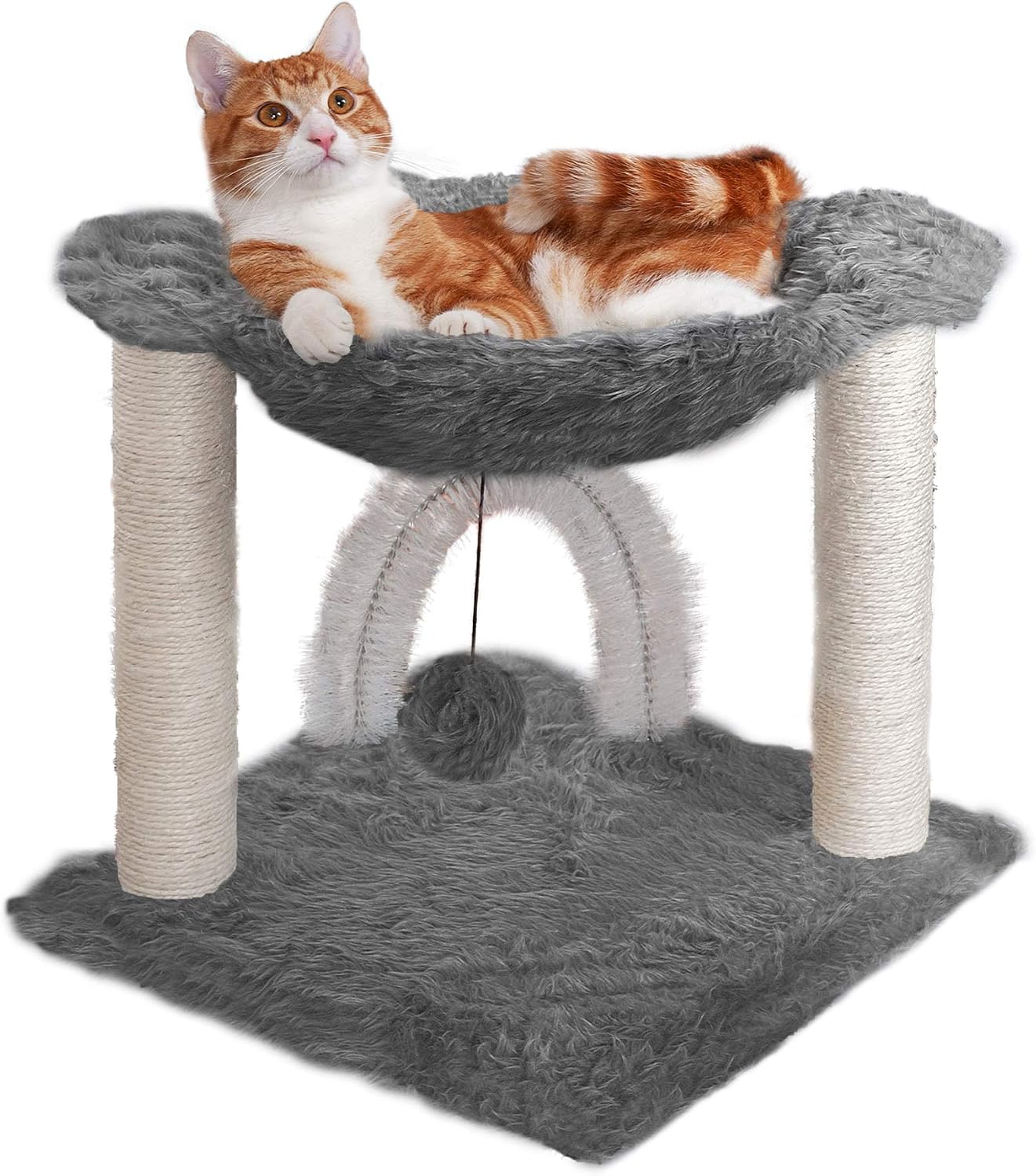
The freestanding anchor: Furhaven 15.75" Tall Playground for Indoor Cats, Ft. Sisal Scratching Posts, Self-Grooming Brush, & Toy - Tiger Tough Hammock Interactive Playground - Silver, One Size
 Visit on Amazon →
This is the piece that handles the ground game. It is a wide, low playground with sisal scratching posts, a hammock, a self-grooming brush, and an interactive toy, built for the cat that wants to rub, scratch, and bat at something without committing to a climb.
The sisal posts are the reason it belongs in this guide. Sisal rope has the texture cats prefer for scratching: rough enough to catch the claw sheath, tough enough to survive repeated use. The hammock gives a cat a low, soft resting spot that does not require a jump, which makes this a good fit for kittens, senior cats, and cats recovering from surgery or an injury. The grooming brush catches cheek and shoulder rubbing, which is how a cat claims a piece of furniture as its own, and the toy keeps a bored cat busy at floor level instead of on your counter.
Where it fits: this is the base layer of a setup, not the whole setup. The height is 15.75 inches, which is low by design. That is a feature for kittens and older cats and a limitation for a healthy adult cat that wants to be above the room. Pair it with something mounted higher and you cover both needs.
Flaws but not dealbreakers: It is a light, low piece, so it does not deliver the high perch a bold adult cat will look for. If you have a cat that already climbs your shelves, this is the second purchase, not the first.
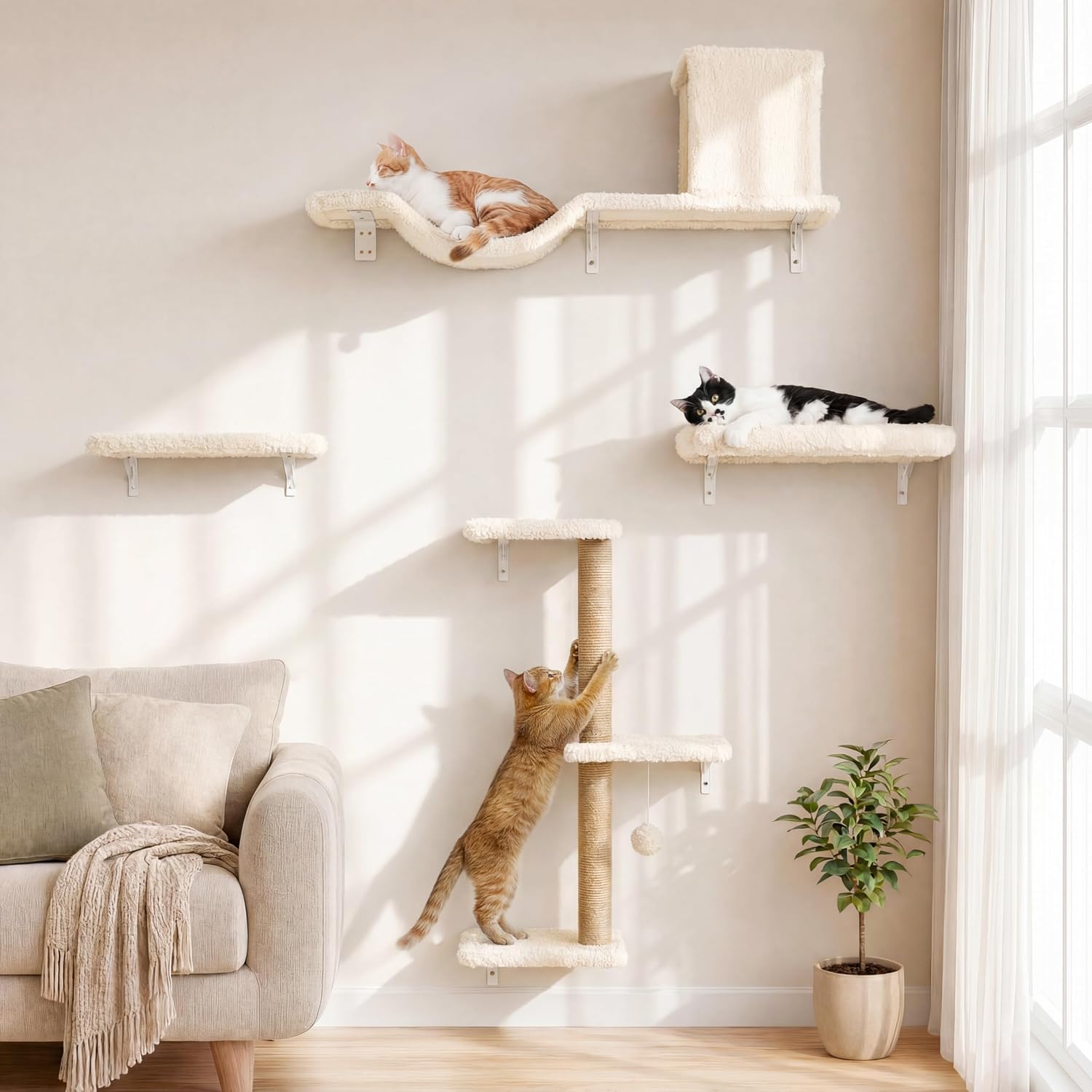
The height layer: FUKUMARU Cat Wall Shelves, 4 in 1 Set, Beige
 Visit on Amazon →
This is the piece that turns a wall into vertical territory. It is a four-piece shelf set in beige, designed to mount to the wall and step a cat upward in stages instead of asking it to leap onto a single high platform.
Wall-mounted shelves solve a problem freestanding trees cannot: they use space you are not using anyway. In a small apartment or a foster room, a floor tree eats the corner it stands in, while shelves sit above the furniture and stay out of the way. For the cat, the appeal is the same either way, which is height plus a route to get there.
The installation is the part that decides whether this works. Shelves are only as good as what they are anchored to. Plan on finding studs rather than trusting drywall anchors, and check the weight rating on the hardware you use. A shelf that pulls out of the wall is worse than no shelf at all, because it teaches the cat that the high perch is not safe.
The beige finish is neutral enough to disappear into most rooms, which matters if the setup is going in a living room instead of a dedicated cat room.
Flaws but not dealbreakers: It requires drilling, so renters should check the lease first, and it needs a wall with usable studs. Old plaster or a stretch of wall with no stud where you need one means rethinking the layout.
The actual setup workflow
Now the part you came for. This works with any stable floor piece and any wall-mounted shelf set, but the two products above are the ones I am describing.
Step one: Pick the room and the wall. Cats want to see the door and the window. A corner that lets a cat watch both is worth more than a bigger setup in a dead-end hallway. Avoid walls above a heater, radiator, or vent, and avoid anything directly in a doorway where the perch becomes a tripping hazard.
Step two: Find the studs before you buy hardware. A stud finder and a roll of painter's tape are the whole kit. Mark every stud across the span you plan to use, because you will want options once you start laying out the steps. If a stud is not where you need one, move the shelf, not the anchor.
Step three: Place the freestanding piece first. Put it where the cat already scratches, or right beside the piece of furniture the cat is currently shredding. This is the detail most people miss. You are not decorating, you are redirecting an existing habit, and the new surface has to be closer than the old one.
Step four: Mount the first shelf low. Start the climb at a height the cat can step onto without a real leap. Kittens, seniors, and heavier cats all need an easy first step. A route that begins with a big jump is a route most cats will not take.
Step five: Space the steps so the cat moves up in stages. The gap between shelves should be a comfortable step or hop for your cat, not a leap of faith. Watch your cat move around the house and match the spacing to what it already does on counters and windowsills.
Step six: End with a landing. The top shelf should fit a sprawled adult cat, not a kitten. A perch that only holds paws is a perch the cat will abandon as soon as a better option appears.
Step seven: Load test with your hands before the cat gets on it. Press down on every shelf, lean on the freestanding piece, and check for flex at the mounting points. Do this on day one and again after a week. Hardware settles, and a wobble you can fix in five minutes is the difference between a used setup and an abandoned one.
Step eight: Let the cat find it. Do not put the cat on the shelf. Put a treat or a favorite toy on it and walk away. Cats claim things on their own schedule, and forcing the introduction is the fastest way to make a piece suspicious.
One caveat that applies to every step: if anything moves, fix it before the cat uses it. Wobble is the single most common reason a climbing setup gets ignored, and it is almost always a hardware problem, not a cat problem.
What this guide leaves out
A tall floor-to-ceiling tree can do everything these two pieces do in one footprint, and if you already own a stable one with sisal posts, you may only need the shelves. That is a real option and I am not arguing against it.
What I am not recommending here is the cheap carpet-wrapped tower. The posts teach the wrong scratching surface, the base plates are usually too small to hold a jumping cat, and the perches are sized for a kitten that will outgrow them in a year. A carpet post does not just fail, it actively trains your cat to scratch carpet, which is a habit you will spend months undoing.
Window perches and cardboard scratchers have their place too, but they solve different problems. Cardboard is a disposable scratching surface, not a structural one. Window perches are seasonal in a lot of homes. Neither one replaces a sisal post and a stable perch.
What this all costs
The two pieces here are priced very differently, and the right way to think about it is not the sticker on the box. Check current Amazon price for each before you decide, because both move.
The math that matters is cost per year of use. A setup a cat actually uses lasts years. The pieces that fail are the ones that wobble, the ones with carpet posts, and the ones too small for the cat that lives there. Every one of those failures ends in a replacement purchase, which is how a cheap tree becomes an expensive tree.
Then there is the hardware: a stud finder, proper lag bolts or heavy-duty anchors rated for the load, and a level. That is a one-time cost, and it is what keeps the wall set from turning into a drywall repair project.
If you are building this for a single cat in a small apartment, start with the height layer and add the floor piece when you find the spot the cat keeps scratching. If you are setting up a foster room with multiple cats, do it the other way around. The floor piece takes the traffic and the scratching, and the shelves give the cats a way to get out of each other's space, which is the thing that keeps a multi-cat room calm.
Build the base, then build the height. Scratch surface first, perch second, hardware before either one. Do it once and your cat stops auditioning the bookshelf.